
Good Fire, Bad Fire
How to tell the difference between 'good' and 'bad' inflammation


When you’re living with cancer, it’s natural to hear the word ‘inflammation’ and immediately worry but your body actually needs some inflammation to heal and fight infections. At times, inflammation may even help your immune system recognise and attack cancer cells.
The challenge isn’t to get rid of all inflammation but to recognise the difference between helpful, controlled, inflammation and less helpful, persistent or chronic inflammation.
What is inflammation?
Inflammation is your body’s natural immune response to injury, infection, or anything else it perceives as harmful to you.
Generally speaking, there are two broad patterns:
Acute (short‑term) inflammation: Comes on quickly after a trigger such as surgery, an infection, or a treatment, and usually settles over days to weeks as healing occurs.
Chronic (long‑term) inflammation: Smoulders on for months or years, sometimes with no obvious single trigger.
I’ll repeat this because it’s important:
Inflammation is your body’s natural immune response to something it sees as harmful.
Local vs Widespread Inflammation
Local inflammation
We all know the classic local signs of inflammation:
Redness
Heat (warmth)
Swelling
Pain
Loss or change of function in the affected area
You might see these, for example, around a surgical wound, a localized infection, a radiotherapy field or an injection site.
Local inflammation also occurs in chronic conditions like osteoarthritis, dermatitis and chronic hepatitis.
Systemic inflammation
However, when inflammation is more widespread, it can induce a ‘sickness behaviour’ cluster of symtoms which can be vague and non-specific:
Persistent tiredness or fatigue that is out of proportion to your activity
Loss of appetite or feeling full quickly
Unintentional weight loss
Brain fog or trouble concentrating
Feeling generally unwell, ‘inflammed’, or as I have complained for many years - “I feel like I’m on fire inside.”
Feeling like you’re running a constant low‑grade flu
Low mood, anxiety or feeling “wired but tired”
Feeling like you’re aging in fastforward
To be clear, many of these symptoms can also be caused by the cancer itself, cancer treatments, sleep disruption or mood changes, and a whole load of other reasons. Inflammation is often part of the picture, but rarely the only explanation.
How blood tests can hint at inflammation
No blood test at a single point in time can tell you whether your inflammation is ‘good’ or ‘bad’ but these markers can serve as useful data points, especially when tracked over time.
Here are some common markers your doctor might look at with you:
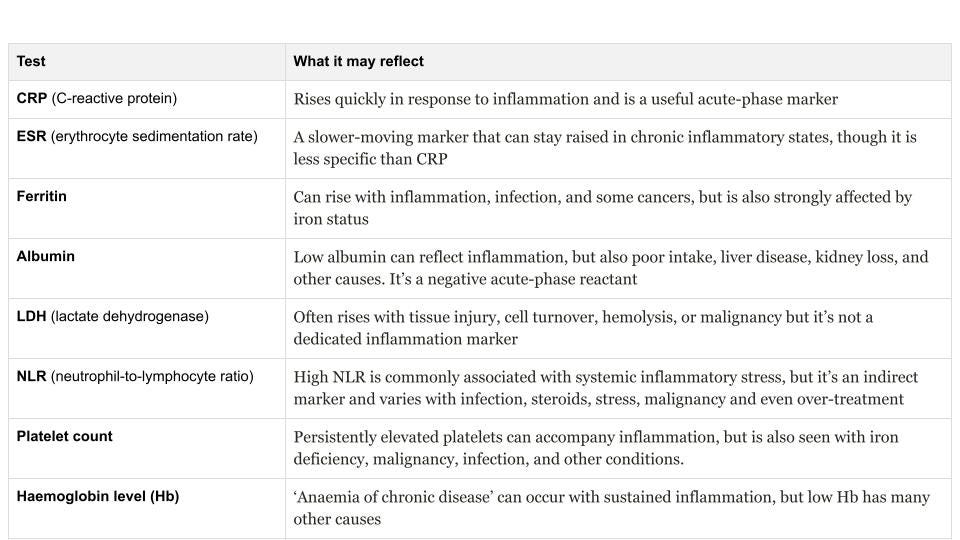
Please note these markers are not specific and they can be influenced by infections, medications, liver function, kidney function and many other factors.
If your markers are elevated but you feel like you are healing overall (energy slowly improving, wounds or radiotherapy reactions settling, weight stable or improving) then your blood inflammation markers should be trending downwards with time.
On the other hand, if inflammatory markers stay high or climb over time and this goes hand in hand with worsening symptoms like fatigue, weight loss or declining function, you may need to discuss what can be done with your care team.
Also, even if your tests look normal, it doesn’t mean you don’t have any issues with inflammation. Some people have significant symptoms even when standard inflammatory markers are in the normal range.
You may not have raging inflammation but still may have the low‑level smouldering kind which many of us have.
What ‘good’ and ‘bad’ inflammation looks like
You can think of ‘good inflammation’ as a controlled burn. Something sets it off, e.g an operation, an infection, a cycle of chemotherapy, radiation or immunotherapy, and your body mounts a response. There is a flare and then a clear settling phase.
‘Bad inflammation’ is often harder to pinpoint because it can creep in slowly. There may be no single obvious trigger but over time there is a build‑up of symptoms that chip away at your reserves.
In simple terms, ‘good inflammation’ is usually acute, purposeful and self‑resolving, while ‘bad inflammation’ is persistent, usually widespread or out of proportion to what is happening.
Bringing it back to you
Let's be honest, if you were dealing with straightforward acute inflammation, you probably wouldn't have found your way to this article. You don't need a blood test or a lengthy read to know when your body is doing exactly what it should after a procedure.
You’re here because you don’t feel well. Maybe you’ve been collecting symptoms over months or even years, and then a cancer diagnosis and its treatments made everything so much worse. It’s very possible that some degree of chronic inflammation is part of what’s going on, layered on top of other contributors like poor sleep, hormonal shifts, deconditioning, and the cumulative toll of treatment.
One way to think about it is that your body is busy ‘keeping the coals alive’. It's spending precious energy maintaining that background inflammatory state, energy that could otherwise be going towards repair, recovery, and healing.
Cancer and its treatments all add to this burden. The body becomes worn down and you go into a kind of ‘energy deficit’, which is one reason why even months or years after treatment ends, some people find they aren't bouncing back the way they hoped.
The question here isn’t “Do I have inflammation?”. What you (and I) are really asking is:
“I don’t feel well. How do I feel better again?”
I wish I could hand you a single magic supplement, herb, or intervention to put the fire out but it's a lot more complex than that. We’ll discuss this in later articles. If you’re not a subscriber, I’d love for you to follow along.
What do you think? I'd love to hear your thoughts. Chronic inflammation is such a complex topic and it deserves robust discussion.
This information is for education only and not a substitute for medical advice. Always consult your healthcare team before making changes to treatments, supplements, or lifestyle. While every effort is made to ensure information is accurate and evidence-informed, no guarantee can be given. The author accepts no responsibility for any loss or harm that may arise from reliance on the information provided.
In my case, I physically feel great, and I was declared to be in remission in January based on a PET scan. I am still taking TDM-1. However, my NLR crept up to 5 fromna high 4 in my last blood test. It is giving me stress, although my oncologist's response to my concern was to tell me I am doing well. (To his credit, he recommended turmeric.) This series came at the right time.